Methods, data and credits
Solar Motion shows where solar-system bodies are and how they move, for any moment between the years 1000 and 3000. Distances are never compressed. Distant worlds can be drawn a few pixels larger than true scale so they stay visible; switch to True scale under Layers to turn that off.
How positions are computed
- Planets and Pluto: Astronomy Engine (VSOP87 for the planets, a dedicated model for Pluto). Accurate to about an arcminute over several thousand years.
- The Moon and Jupiter’s four large moons: Astronomy Engine’s lunar theory and the E5 theory of the Galilean satellites.
- The other 465 cataloged moons: JPL Solar System Dynamics mean orbital elements (precessing ellipses), snapshot of September 2026. JPL notes these elements describe orbit shape and orientation rather than serving as a precise ephemeris.
- Rotation: IAU Working Group on Cartographic Coordinates and Rotational Elements models, so Earth’s day side, the Moon’s face and Jupiter’s bands are oriented correctly for the moment shown.
- Asteroids and comets: 120,000 real objects from the JPL Small-Body Database, each moved along a two-body Kepler orbit on your graphics card. Planetary perturbations are ignored, so positions drift over decades, especially for comets and near-Earth asteroids.
- Spacecraft: trajectories from JPL Horizons, sampled densely around planetary flybys.
- Eclipses and events: computed live by Astronomy Engine. Eclipse shadows on the globe are drawn by finding, for each point, how much of the Sun’s disk is covered.
- Stars: the Yale Bright Star Catalog, 5th edition (9,096 stars to about magnitude 6.5). Constellation figures from d3-celestial by Olaf Frohn (BSD-3-Clause).
- Sky from Earth: the camera stands at Earth’s center and looks out, so planets trace their true apparent paths, including retrograde loops, against the real stars. The view is geocentric (no horizon, no atmospheric refraction) and oriented with ecliptic north up.
Reference frames
Motion is always measured relative to something. The same orbits look different depending on what is held still:
- Sun at rest: the classic heliocentric view.
- Center of mass: the solar system barycenter. The Sun itself wobbles around it, mostly because of Jupiter and Saturn.
- Earth at rest: the geocentric view. Planets trace retrograde loops.
- Galaxy: relative to the Milky Way’s center. The Sun moves about 245 km/s (a 232.8 km/s circular speed, McMillan 2017, plus the Sun’s peculiar motion, Schönrich et al. 2010). Over the spans shown, that path is effectively straight; one trip around the galaxy takes over 200 million years.
- Cosmos: relative to the cosmic microwave background, 369.82 km/s toward the constellation Crater (Planck 2018).
None of these frames is the “true” one. Each is a valid description of the same motion.
Image credits
- Saturn ring color + alpha (8k): Solar System Scope / INOVE, CC BY 4.0. Source
- Charon (New Horizons): NASA/JHUAPL/SwRI, NASA/JPL image use policy (no copyright; credit required). Source
- Io: NASA/JPL-Caltech; David Seal; Caltech/JPL/USGS, JPL image use policy (credit required, no endorsement implied). Source
- Deimos (Viking): NASA/JPL-Caltech; Caltech/JPL/USGS, JPL image use policy (credit required, no endorsement implied). Source
- Oberon (Voyager 2, southern hemisphere): NASA/JPL-Caltech; Caltech/JPL/USGS; Tammy Becker, JPL image use policy (credit required, no endorsement implied). Source
- Titan surface, near-infrared 938 nm (Cassini): NASA/JPL-Caltech/University of Arizona, NASA/JPL image use policy (no copyright; credit required). Source
- Iapetus (Cassini enhanced color): NASA/JPL-Caltech/Space Science Institute/Lunar and Planetary Institute, NASA/JPL image use policy (no copyright; credit required). Source
- Vesta (Dawn FC HAMO global mosaic): NASA/JPL-Caltech/UCLA/MPS/DLR/IDA; USGS Astrogeology Science Center, Public domain (U.S. Government work; cite authors). Source
- Phobos (Viking global mosaic): Phil Stooke; NASA Viking; USGS Astrogeology Science Center, Public domain (U.S. Government work; cite authors). Source


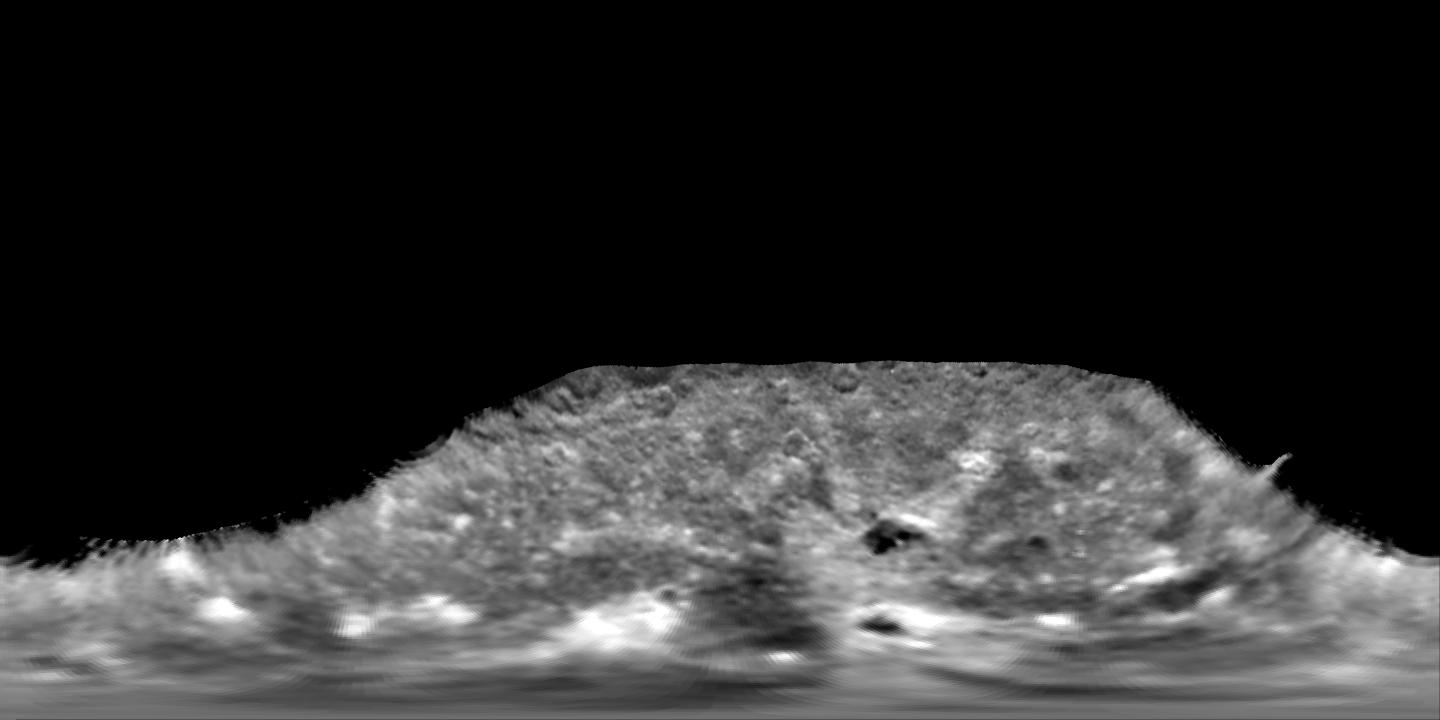
Solar System Scope textures are by INOVE, licensed CC BY 4.0, resized and re-encoded. Moon mosaics from NASA, JPL, USGS and partner institutions keep their original missing-data areas in black. Cassini moon maps are enhanced color. NASA and JPL material does not imply endorsement.
Software
Built with three.js (MIT) and Astronomy Engine (MIT). Fonts: Geist and Geist Mono (OFL), Fraunces (OFL).